You are two drinks into a party and someone mentions free will, or generation ships, or why every social network eventually gets worse—and your brain lights up like a switchboard. Then the moment passes, the conversation slides back to traffic, and you spend the ride home wondering why the good part lasted ninety seconds.
If you crave conversations with actual substance but hold back—because you fear seeming pretentious, or because nobody around you seems to want them—the problem is rarely your interests. It is two learnable skills: reading who wants depth, and escalating toward it in a way people can comfortably follow. This guide covers both, plus where to find people for whom the deep end is the fun part.
What Intellectual Conversation Actually Is
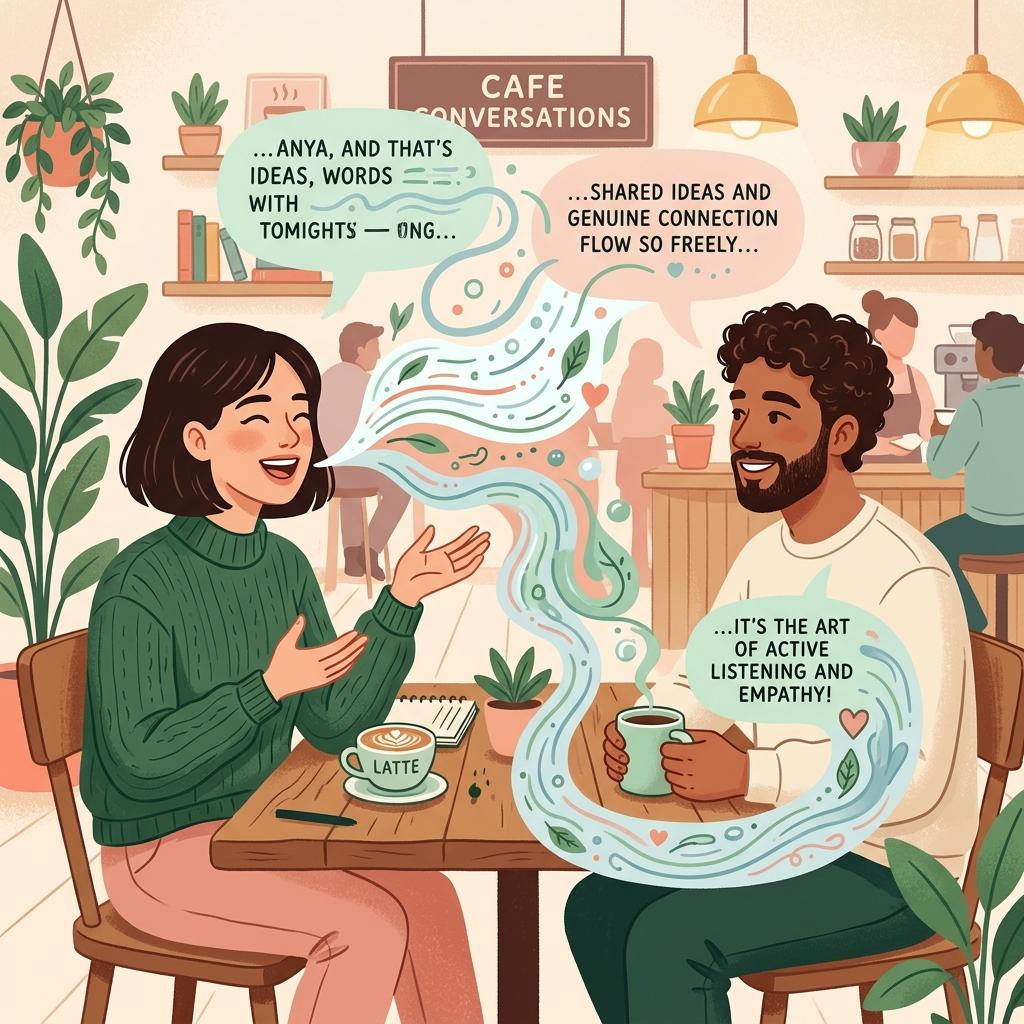
Strip away the intimidating label and intellectual conversation is just shared curiosity with momentum: two or more people examining a question together because the examining itself is enjoyable. The topic can be consciousness or it can be why cats knock things off tables. What makes it intellectual is the mode—wondering, comparing models, following implications—not the vocabulary.
This is worth stating because two impostors wear the same label. Vocabulary flexing is using conversation to display knowledge: name-drops, jargon, the subtle quiz. Debate-winning is using conversation to defeat someone: scoring points, hunting contradictions, treating every claim as a position to attack. Both are performances with an audience, and both make people quietly resolve never to bring up an interesting topic around you again.
Real intellectual conversation is collaborative by definition. The unit of success is not 'I sounded smart' or 'I was right'—it is we ended up somewhere neither of us started. Hold that as the goal and most of the pretentiousness risk evaporates on its own, because the behaviors that read as pretentious are exactly the ones that break collaboration.
Read Whether Someone Wants Depth First
The most common failure mode is not being boring—it is dragging someone into deep water who came to wade. Some people find idea-talk delightful; others find it exhausting, showy, or like an exam they did not study for. Neither group is wrong. Your job is to find out which one you are talking to before delivering the twenty-minute version.
The tool is the offered door: a small, explicitly optional invitation to go deeper. 'I read something counterintuitive about this recently—want the tangent?' 'There's a genuinely weird rabbit hole here if you're interested.' 'Okay, I have a theory, stop me if this is too nerdy for a Tuesday.' The framing does the work: it signals that depth is available and that declining is completely fine.
Then watch the response. Leaning in—follow-up questions, 'wait, what do you mean?', their own examples—means the door is open; go. Polite tolerance—'huh, interesting' with drifting eyes, a topic change, answers getting shorter—means close the door gracefully and return to lighter ground. This is the same cluster-reading skill from how to have better conversations: one cue is noise, a pattern is an answer.
Offer doors early and cheaply. A ten-second teaser that gets declined costs nothing and is instantly forgotten. A ten-minute monologue that lands wrong costs the rest of the evening. The depth of the conversation should be set by the most reluctant person in it.
10 Starters That Escalate From Casual to Deep
Good depth-questions share a shape: easy entry, story-friendly, and roomy enough that the answer can go somewhere. These are ordered roughly from lowest to highest commitment—start shallow and climb as the energy allows. For lighter warm-up material to get there, keep casual questions that lead somewhere in your back pocket.
1. What's a rabbit hole you fell down recently? — The gentlest opener on the list; it invites enthusiasm rather than analysis.
2. What's something you're surprisingly opinionated about? — Low stakes, high energy, and instantly reveals where their fun topics live.
3. What's the best thing you've read, watched, or listened to this year—and what made it stick? — The second half is the question; it asks for reasons, not just titles.
4. What's something you've changed your mind about? — Quietly one of the best questions in existence. It invites a story, rewards honesty, and signals that changing your mind is admired here, not attacked.
5. What do you think people in fifty years will find baffling about how we live now? — A hypothetical with a built-in excuse to speculate freely.
6. What skill or field do you think is completely underrated? — Invites them to advocate for something, which is energizing rather than exposing.
7. Is there a common belief you suspect is wrong, but you can't prove it? — The word 'suspect' lowers the burden of proof and licenses interesting half-formed thoughts.
8. If you had to defend the opposite of one of your own opinions, which could you argue best? — Steelmanning as a party game; it turns rigor into play.
9. What question do you wish someone would ask you? — Meta, disarming, and hands them the microphone for whatever they have been thinking about lately.
10. What's a problem you'd love to see solved in your lifetime? — Ambitious without being heavy; it surfaces values through the side door.
Discuss, Don’t Lecture: The 60-Second Rule
The moment you find a willing partner, a new hazard appears: you finally have permission to talk about the good stuff, and the backlog comes out as a lecture. Enthusiasm plus a captive audience is how people who hate monologues end up delivering them.
Use the 60-second rule: no conversational turn longer than about a minute without handing the ball back. A minute is plenty to make one real point with one example. Then return it—'does that match your experience?', 'am I missing something obvious?', or simply stopping so they can react. If what you know genuinely needs ten minutes, deliver it in installments and let their questions pull it out of you; being asked to continue means the depth is wanted.
Between turns, check engagement like you would check mirrors while driving: are they contributing ideas or just nodding? Are their answers growing or shrinking? Explaining a complex thing compellingly is its own craft—how to explain what you do without boring everyone covers the compression tricks—but in conversation the headline is simple: a discussion you are winning on airtime is a discussion you are losing.
Lecture mode: 'Actually, the interesting thing about memory is—' followed by four minutes of neuroscience. Discussion mode: 'I read that we partly rewrite a memory every time we recall it—which honestly creeps me out. Does that match how remembering feels to you?' Same fact, but the second version buys a partner instead of an audience.
Disagree Playfully, Not Forensically
Disagreement is where intellectual conversation either becomes great or becomes a courtroom. The courtroom version treats the other person's claim as testimony to dismantle: objection, counterexample, gotcha. You may win, but you have taught everyone present that sharing a half-formed idea around you is dangerous—and half-formed ideas are the entire raw material of good conversation.
The collaborative version treats disagreement as a shared puzzle: we see this differently—interesting, let's find out why. The workhorse phrase is 'walk me through how you got there'—it takes the other person's position seriously and usually reveals that you disagree about a premise, a definition, or a piece of evidence rather than about logic. Other tools: 'the strongest version of your argument, to me, is...' (steelmanning aloud), 'here's where you start losing me,' and the honest 'I might just be wrong about this, but...'
Keep the register light. Playful disagreement sounds like 'okay, I am going to push back, prepare yourself'—it names the disagreement while signaling that the relationship is not in question. And concede visibly when someone lands a point: 'huh, that one I have no answer for.' Nothing builds trust in a discussion faster than proof that you can lose a point gracefully, and nothing invites depth like being someone with whom being wrong is safe.
Where to Find People Who Want This
If your current circle meets your depth-offers with polite tolerance, hear the actual message: not 'depth is unwelcome everywhere,' just 'not this room.' Plenty of people are starving for exactly the conversations you are suppressing. You find them by going where discussion is the built-in activity, not an interruption of it.
Book clubs are structured intellectual conversation with a syllabus. Tabletop and D&D groups are hours of collaborative problem-solving with built-in breaks for tangents, and joining one as a beginner is far easier than most people assume. Meetups and lecture events—philosophy cafés, science talks, maker spaces—preselect for the curious. Online communities built around a specific interest often host the best written discussions available, and nerd friendships made online transfer offline more readily than people expect. Communities that celebrate deep enthusiasm exist everywhere—that is half of what nerd culture actually is.
Prefer recurring groups over one-off events. Depth is partly a function of familiarity: the fourth session with the same people reaches places a first meeting cannot, because everyone has learned that ideas are safe there.
The Pretentiousness Fear, Handled
The fear that keeps most thoughtful people in small-talk mode is sounding pretentious. Here is the diagnostic that dissolves it: pretentiousness is performance; curiosity is participation. Performance points at the speaker—look what I know, look how I talk. Participation points at the question—help me figure this out. People detect the direction almost instantly, and they forgive enormous nerdiness in someone who is genuinely trying to figure something out with them.
The practical translation: use the plain word when it works. Ask questions you do not know the answers to. Say 'I don't know' and 'I might be wrong' out loud. Let yourself be visibly delighted when someone tells you something new—delight is the least pretentious signal a human can send. The person who says 'wait, that breaks my whole model, say more' is never the pretentious one in the room, no matter what the topic is.
So run the experiment this week: in one conversation, offer one door. A teaser, a question from the list, a 'want the nerdy version?' If it gets declined, you lost ten seconds. If it gets taken, you may have found one of your people—and one genuinely mutual deep conversation is worth a month of weather reports.
Watch the correction reflex. Correcting someone's harmless imprecision mid-story—'well, technically...'—is the fastest way to make idea-talk feel like an exam. Save precision for when it changes the conclusion; let it go when it only changes the wording.
Frequently Asked Questions
What is intellectual conversation?
It is conversation driven by shared curiosity about ideas—examining a question together, comparing models of how something works, or exploring a topic past the surface level. It is defined by the mode of engagement, not the subject or the vocabulary. Two people genuinely puzzling over why sequels disappoint are having a more intellectual conversation than two people reciting facts at each other.
How do you start an intellectual conversation without being awkward?
Start inside a normal conversation and offer a door rather than forcing one open: 'I fell down a rabbit hole about this recently—want the nerdy version?' If they lean in, go deeper; if they give a polite nod and change the subject, stay in casual mode. Questions like 'What's something you've changed your mind about?' escalate naturally because they invite a story, not a thesis.
How do I talk about ideas without sounding pretentious?
Pretentiousness is performance—signaling that you know things. Curiosity is participation—showing that you want to figure things out, including being visibly wrong sometimes. Use plain words when they work, keep turns short, ask real questions about the other person's view, and say 'I don't know' when you do not. Curiosity almost always reads as warmth.
Where can I find people who like deep conversations?
Go where discussion is the built-in activity: book clubs, philosophy or science meetups, tabletop and D&D groups, university-adjacent lectures, hackathons, and online communities organized around a specific interest. Recurring groups beat one-off events, because depth grows with familiarity and repeated contact.
Sources
- Kardas, M., Kumar, A., & Epley, N. (2022). Overly shallow?: Miscalibrated expectations create a barrier to deeper conversation. Journal of Personality and Social Psychology, 122(3), 367–398.
- Huang, K., Yeomans, M., Brooks, A. W., Minson, J., & Gino, F. (2017). It doesn't hurt to ask: Question-asking increases liking. Journal of Personality and Social Psychology, 113(3), 430–452.
- Hall, J. A. (2019; online first 2018). How many hours does it take to make a friend? Journal of Social and Personal Relationships, 36(4), 1278–1296.
- Lee, J. L. C., Nader, K., & Schiller, D. (2017). An update on memory reconsolidation updating. Trends in Cognitive Sciences, 21(7), 531–545.
Your next real-world rep
State a real opinion
When it fits a conversation today, share a preference or opinion you actually hold. You can agree with someone sincerely; disagreement is not required.
Try this challenge →