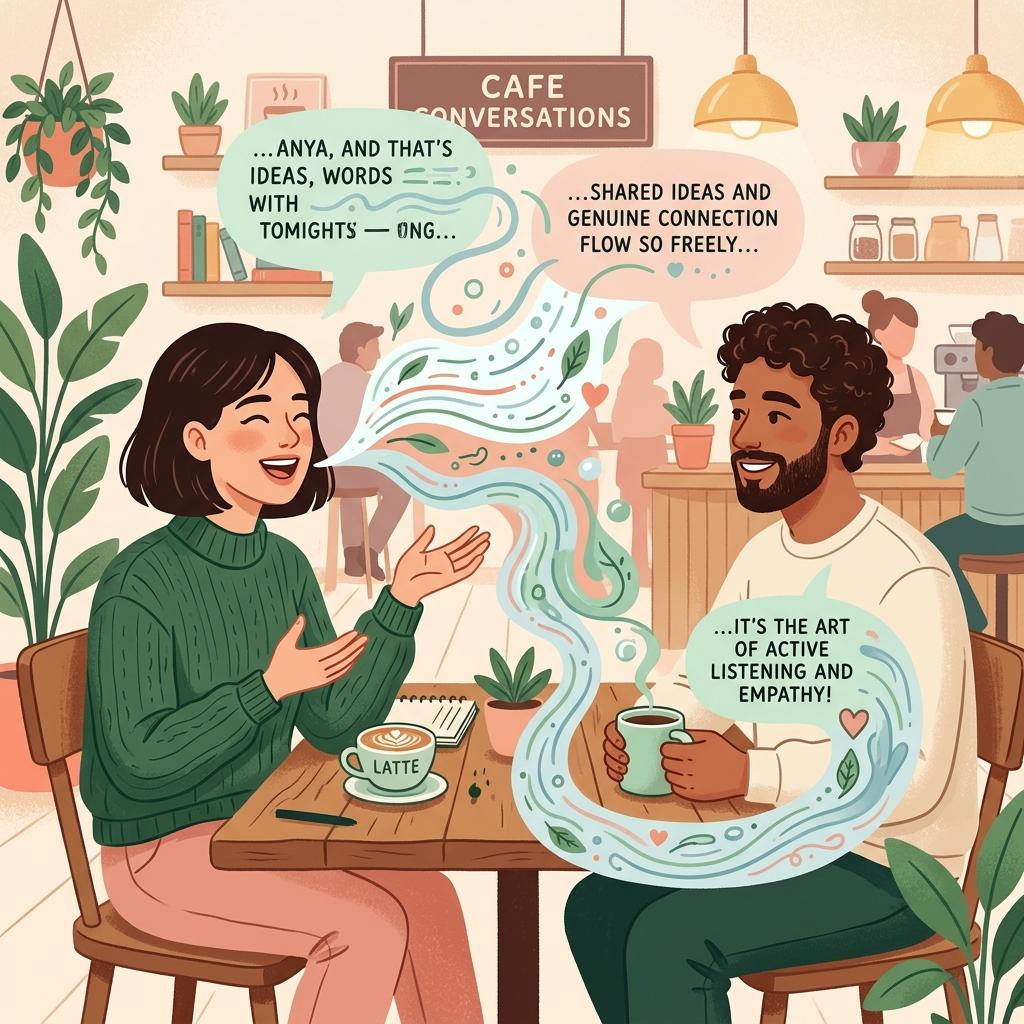
You are standing next to someone at the coffee machine, in a queue, or at the edge of a party, and the silence is getting louder. You know you are supposed to say something. You also know that 'nice weather' is a content-free statement, and your brain refuses to say things with no content.
That refusal is the whole problem. Small talk feels pointless to analytical people because they evaluate it as information exchange, and by that measure it is terrible. But small talk is not information exchange. It is a signal, and once you understand what it signals, it becomes a simple procedure you can run without dread.
This guide gives you the structure, the topics that reliably work, twenty questions with follow-ups, four short example dialogues, and the exits. If the whole subject of conversation feels hard, not just the opening minutes, how to have better conversations is the broader guide.
What Small Talk Is Actually For
You can think of small talk as a light check that conversation is welcome. A comment about a shared situation gives someone an easy way to respond or keep the exchange brief. It does not establish safety, trust, or permission to ask something personal.
An easy question can lower the effort needed to join an exchange, but people differ in what feels easy. A question about an activity may suit one person; a direct discussion of a shared interest may suit another. You do not have to make light conversation before every substantive topic.
This also explains why skipping small talk backfires. People who open with intensity are not being efficient; they are transmitting data before the connection is confirmed. Two or three light exchanges are the price of admission for everything you actually want to talk about, including turning that first chat into a real friendship.
You do not have to enjoy the content of small talk. You only have to run the protocol. The enjoyable conversation is what the protocol unlocks.
The Three-Step Structure: Open, Follow Up, Share
One possible structure is an observation, a question, and a response to the answer. Use it as a starting point rather than a script you must repeat a set number of times.
1. Open with the shared situation. Comment on or ask about something you both have access to: the event, the venue, the wait, the weather, the food, the talk you both just sat through. 'Have you been to one of these before?' 'Is the coffee here any good?' Shared context needs no explanation and cannot be wrong.
2. Follow up on their answer. This is the step most people skip, and it is the one that makes small talk feel like conversation instead of a survey. Whatever they say contains a thread. 'First time, actually.' 'Oh, what brought you?' One follow-up per answer is enough.
3. Share something back. After one or two questions, give them something from your side so they can ask you something too. 'I only came because a friend bailed on me, honestly.' A small, slightly self-revealing statement is what turns two people into a conversation.
Run the loop twice and you are past the handshake. At that point one of two things happens: a real topic surfaces and you follow it, or it does not and you exit. Either outcome is a success. For what to do once a topic catches, see how to keep a conversation going.
Small Talk Topics That Work (and Two That Don't)
The shared situation. An event or activity can provide an easy opening: 'Have you tried this game before?' Check the context first. A medical waiting room, private conversation, or busy work moment may call for privacy rather than chat.
Plans and what they are looking forward to. 'Anything good coming up this week?' beats 'how was your weekend?' because it points forward and gives them a chance to talk about something they are excited about.
Enthusiasms. 'What are you into outside work?' or, if you know one thing about them, ask about that one thing. People light up describing what they love, and the light is what you are after.
Food, coffee, and local knowledge. 'Is there anywhere good to eat around here?' is a question almost everyone can answer and usually enjoys answering. Asking for a recommendation also creates a reason to report back later.
Low-stakes opinions. 'Is this a good venue for these things or is it always this loud?' Small opinions are engaging without being risky.
Two topics to avoid early: anything that requires trust you have not earned yet, like health, money, politics, or relationship status; and 'how are you?' treated as a real question. It is a greeting. If you want a real answer, ask a real question: 'How has your week been going?'
20 Small Talk Questions With Follow-Ups
Each question comes with a follow-up, because the follow-up is where the conversation actually starts.
At work or at the coffee machine: 'How is your week going so far?' then 'What is eating the time?' — 'Are you on the release thing too?' then 'How is it looking from your side?' — 'Any plans for the long weekend?' then 'Is that a regular thing or a one-off?' — 'How was the offsite?' then 'What was the one useful part?' — 'Did you see the thing in the all-hands?' then 'What did you make of it?'
At a party or an event: 'How do you know the host?' then 'So you go way back?' — 'Have you been to one of these before?' then 'How does this one compare?' — 'Did you try the food yet?' then 'What is worth going back for?' — 'Are you local or did you travel for this?' then 'What has the trip been like?' — 'What is the best thing you have seen tonight?' then 'What made it good?'
Waiting with a stranger: 'Is it always this busy in here?' then 'Do you come here a lot?' — 'Do you know if this line actually moves?' then 'Is there a better time to come?' — 'Are you here for the same thing I am?' then 'How did you hear about it?' — 'What is your dog's name?' then 'How old is she?' — 'That announcement cleared nothing up for me. Did you catch it?' then 'So what is the plan now?'
Someone you see regularly but barely know: 'You are here every Tuesday too, right?' then 'How long have you been coming?' — 'How did last week's thing go?' then 'Would you do it again?' — 'I keep meaning to ask, what do you actually do?' then 'How did you end up in that?' — 'Are you doing the thing next month?' then 'What is the appeal for you?' — 'Any recommendations for a beginner?' then 'What did you wish you knew when you started?'
If you want more openers sorted by situation, conversation starters for nerds has 50 of them, and casual questions to get to know someone picks up where small talk ends.
Small Talk Examples: Four Short Dialogues
At the office coffee machine. You: 'Is this thing working today, or is it in one of its moods?' Them: 'It made me a coffee, so I think we are fine.' You: 'A rare win. How is your week going?' Them: 'Busy. Release is Thursday.' You: 'The mobile one? How is it looking?' Them: 'Mostly fine, one flaky test.' You: 'There is always one. Good luck with it.' Total time: forty seconds. Next week you can ask how the release went.
At a party where you know nobody. You: 'How do you know Priya?' Them: 'We were roommates in college.' You: 'So you have known her through several haircuts.' Them: 'At least four.' You: 'I only know the current one. I work with her.' Them: 'Oh, so you are on the team she complains about lovingly.' Now you have a shared topic, a joke, and a share-back on both sides.
Waiting in line. You: 'Is it always this busy here?' Them: 'Only on weekends.' You: 'Ah, rookie mistake. Is it worth the wait?' Them: 'The pastries are, the coffee is fine.' You: 'Noted. I will pretend I came for the pastries.' Then the line moves and it ends by itself, which is exactly why waiting situations are the best practice arena.
The person you see at the gym every week. You: 'You are here every Tuesday too, right?' Them: 'Yeah, it is the only slot that works.' You: 'Same. How long have you been coming?' Them: 'About a year.' You: 'Any advice for someone three weeks in?' Them: 'Do not skip the warm-up.' You: 'I will stop skipping the warm-up. See you next week.' A small commitment to a next time is what turns a regular face into an acquaintance.
Notice the pattern in every dialogue: observation about the shared situation, one easy question, one follow-up, one small share-back. Nobody is witty. Nobody needs to be.
How to End Small Talk Gracefully
Analytical people often stay in small talk too long because they do not know how to leave it. Knowing the exits makes entering easier.
The reason exit: 'I am going to grab some food before it disappears. Good talking to you.' Any small, true reason works.
The hand-off: 'Have you met Jordan? You two are both doing the AI thing.' Introducing them to someone else ends your conversation and does them a favor.
The loop-close: 'Well, good luck with the release Thursday.' Referencing something they said closes the conversation warmly and proves you were listening.
The future hook: 'See you next Tuesday' or 'Let me know how the pastries were.' A tiny commitment to a next time is the best exit, because it turns one small talk into the start of a pattern.
Exiting after a few minutes is not rude. Lingering while both people run out of things to say is what makes small talk feel painful, and research on conversation endings finds that people can rarely tell when their partner wants to wrap up, so a clean exit spares you both the guessing.
Small Talk for Introverts and Analytical Minds
Introverts do not lack small talk ability; they lack tolerance for the energy cost of improvising it. So stop improvising. Prepare two openers and two follow-up questions before an event, and treat them as a script you are allowed to reuse. Reusing the same opener with ten different people is not lazy; it is how many people who are good at this do it.
Adopt the one-question rule: you only ever need to ask one question at a time. The pressure to be interesting comes from imagining the whole conversation. You are only responsible for the next line.
Tolerate small silences. A two-second pause feels enormous from inside your head, but your conversation partner is judging the moment far less harshly than you are. The other person is usually just thinking.
And budget it. Three short conversations and a clean exit is a successful evening. If you find yourself replaying every exchange afterward, that is a separate habit, covered in how to stop overthinking conversations, and if the whole thing drains you within an hour, what a social battery actually is explains how to plan around it.
How to Practice Small Talk
Small talk is a skill with a short feedback loop, which makes it the easiest social skill to practice deliberately. The practice unit is one exchange, not one evening.
Micro-reps with strangers. Ask a cashier one real question and respond to the answer once. Comment on the wait to the person next to you. Ask a barista what they would order. Each is a ten-second rep of the whole protocol. If you want the rep chosen for you, the free daily challenge starts exactly here.
Rehearsal at home. Say your two openers out loud, not in your head. Shadow a podcast host's follow-up questions. How to practice social skills alone has the full method.
A simulated room. If a real event still feels like too big a first step, the networking event practice scenario lets you run the arrival, the opener, and the exit with an AI that reacts like an actual attendee, and then tells you where the conversation went flat.
Then take it live. One real exchange this week, using the three-step structure, is worth more than everything you have read here. The protocol only becomes yours when you have run it a few dozen times.
Your Action Step
Pick one opener from the shared-situation list and one follow-up question. Use them once today with someone you would normally stay silent next to. Follow up on whatever they answer, share one small thing back, and exit after a couple of minutes.
That is the entire skill. Everything else is repetition.
Frequently Asked Questions
What is small talk?
It is light conversation about an accessible topic, such as a shared activity or a general plan. It can exchange information, express friendliness, or open a longer conversation. It does not prove that a person is safe or create an obligation to talk further.
How do I make small talk when I have nothing to say?
If conversation fits the setting, ask one question about the shared activity: 'Have you been to this meetup before?' Listen and respond, then share a little if it fits. Silence is also allowed, especially when the other person is busy or wants privacy.
Is small talk necessary?
Not always. Some people prefer to start with a shared task or topic. Light conversation can be a useful entry point, but a few exchanges do not earn access to personal details. Let both people choose the depth.
How long should small talk last?
There is no set duration. It may be a brief greeting or a longer exchange. Continue while both people want to, and end naturally when one needs to return to something else.
How can I make small talk over text?
Use a relevant question or observation and leave time for a reply. Respond to what they say and share something of your own. Avoid sending a string of questions when they have not had a chance to answer.
Sources
- Malinowski, B. (1923). The problem of meaning in primitive languages. Supplement I in C. K. Ogden & I. A. Richards, The Meaning of Meaning (3rd ed., 1930). Kegan Paul, Trench, Trubner.
- Huang, K., Yeomans, M., Brooks, A. W., Minson, J., & Gino, F. (2017). It doesn't hurt to ask: Question-asking increases liking. Journal of Personality and Social Psychology, 113(3), 430-452.
- Boothby, E. J., Cooney, G., Sandstrom, G. M., & Clark, M. S. (2018). The liking gap in conversations: Do people like us more than we think? Psychological Science, 29(11), 1742-1756.
- Mastroianni, A. M., Gilbert, D. T., Cooney, G., & Wilson, T. D. (2021). Do conversations end when people want them to? Proceedings of the National Academy of Sciences, 118(10), e2011809118.
Your next real-world rep
Ask a cashier how their day is going
During an unhurried transaction, ask the cashier or barista a brief question such as "How is your day going?" Keep it short and follow their lead.
Try this challenge →